Types of Electronic Signatures: Electronic, Advanced and Qualified Signatures

Not every document requires the same type of signature. The right solution depends primarily on the type of document, how it will be used, and whether regulations or the other party require a specific type of signature.
Under the eIDAS Regulation, there are three basic levels of electronic signatures:
- Electronic Signature (SES),
- Advanced Electronic Signature (AES),
- Qualified Electronic Signature (QES).
They differ, among other things, in how the signatory is identified, their technical requirements, and their legal effects.
Table of content
Electronic Signature (SES)
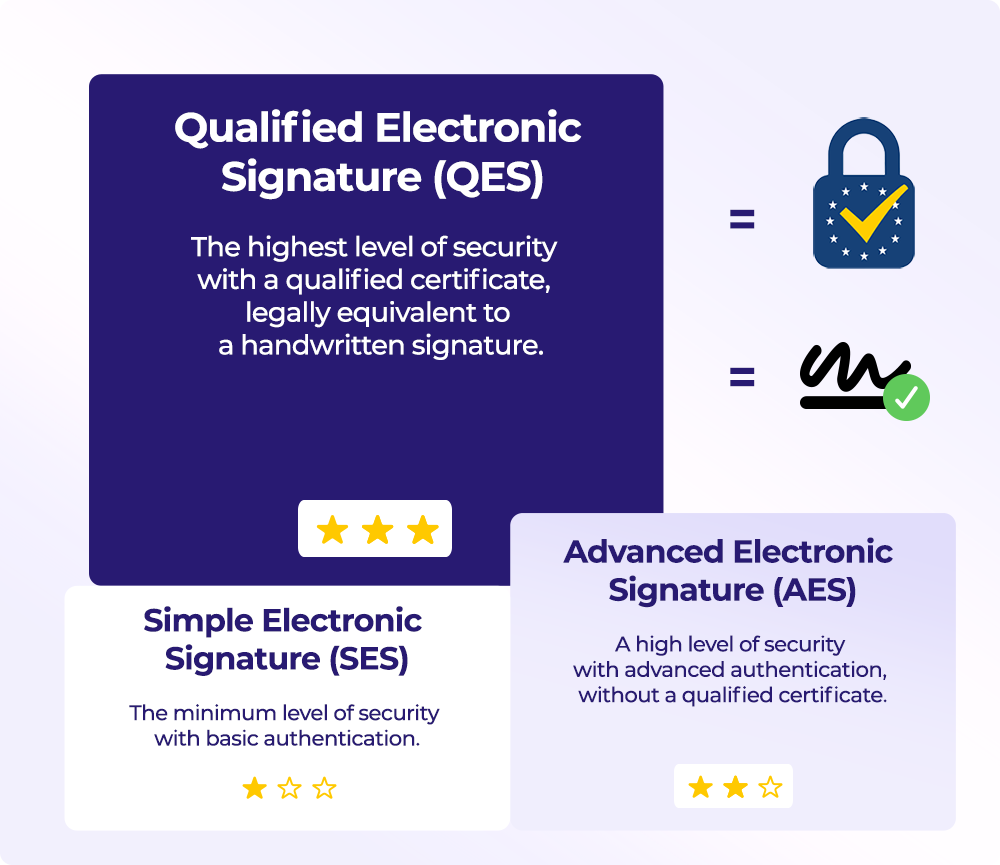
Electronic Signature (SES) is the basic type of electronic signature. It does not require a qualified certificate or a special device.
It can be used to confirm acceptance of documents and perform everyday electronic activities. In practice, the way such a signature is created depends on the solution and process used.
Electronic Signature (SES) is primarily suitable where there is no requirement to use an Advanced Electronic Signature or Qualified Electronic Signature.
Examples of Electronic Signature use
An Electronic Signature can be used, among other things, for:
- document acceptance,
- forms and consents,
- internal documents,
- simple business processes,
- documents for which a higher level of security is not required.
Important: using an Electronic Signature does not automatically mean that a document has the same legal effect as a document signed by hand. The legal effect depends on the type of document, applicable regulations, and the circumstances in which it was signed.
Advanced Electronic Signature (AES)
Advanced Electronic Signature (AES) provides a higher level of security than a basic Electronic Signature.
Under the eIDAS requirements, an Advanced Electronic Signature must, among other things, be uniquely linked to the signatory, enable the signatory to be identified, remain under the signatory’s control, and make it possible to detect subsequent changes to the signed document.
This means that an Advanced Electronic Signature can be used in processes where confirming the identity of the signatory and the integrity of the document is important.
Examples of Advanced Electronic Signature use
An Advanced Electronic Signature can be used, among other things, for:
- HR documents,
- acceptance reports,
- operational documentation,
- internal company processes,
- documents requiring a higher level of signatory identification.
An Advanced Electronic Signature is not the same as a Qualified Electronic Signature. AES does not automatically have the same legal effect as a handwritten signature.
Qualified Electronic Signature (QES)
Qualified Electronic Signature (QES) is the most formalized type of electronic signature defined by eIDAS.
To create one, a qualified electronic signature certificate and a solution meeting the requirements set out in the regulations are required. Before the certificate is issued, the identity of the person who will use the signature must also be verified.
The most important feature of a Qualified Electronic Signature is its legal effect.
A Qualified Electronic Signature has the same legal effect in the European Union as a handwritten signature.
When is a Qualified Electronic Signature used?
A Qualified Electronic Signature may be required, among other situations, when:
- you are signing a B2B agreement or an employment contract,
- a contractor or procedure requires a Qualified Electronic Signature,
- a document must be signed using a signature equivalent to a handwritten signature,
- regulations require a Qualified Electronic Signature,
- the highest level of formal confirmation of an electronic signature is required.
This does not mean that every legally important document must be signed with a Qualified Electronic Signature. If a particular process does not require QES, an Electronic Signature or Advanced Electronic Signature may be sufficient.
Electronic, Advanced and Qualified Signatures – Differences
| Feature | Electronic Signature (SES) | Advanced Electronic Signature (AES) | Qualified Electronic Signature (QES) |
|---|---|---|---|
| Level | basic | advanced | qualified |
| Signatory identification | depends on the process used | required | required |
| Link between the signature and the signatory | possible, depending on the method used | required | required |
| Document integrity | may be ensured by the technology used | required | required |
| Qualified certificate | no | no | yes |
| Equivalent to a handwritten signature | no | no | yes, under eIDAS |
| Typical use | documents where verification by SMS or email is sufficient | documents requiring strong identification and a high level of security | documents requiring a form equivalent to a handwritten signature |
Which type of Electronic Signature should you choose?
The choice should primarily be based on the requirements of the specific document.
Electronic Signature (SES) can be used when you need a simple way to confirm acceptance or sign a document and neither regulations nor the process require a higher level of signature.
Advanced Electronic Signature (AES) is suitable when clear identification of the signatory, control over the signing process, and the ability to detect changes to the document are important.
Qualified Electronic Signature (QES) should be used when a qualified signature is required or when a signature with the same legal effect as a handwritten signature is required.
Therefore, before choosing a type of signature, it is worth checking the requirements applicable to the specific document or process, rather than relying solely on the level of security.
Is a Qualified Electronic Signature always required?
No. This is one of the most common questions about electronic signatures.
A Qualified Electronic Signature is not required for every document. In many everyday processes, an Electronic Signature (SES) or Advanced Electronic Signature (AES) may be sufficient.
However, if regulations, a public authority, a procedure, or the other party requires a Qualified Electronic Signature, you should use Qualified Electronic Signature (QES).
For documents with particular legal significance, it is worth checking the requirements applicable to the specific transaction in advance.
Is an Electronic Signature valid throughout the European Union?
Electronic signatures are regulated at the European Union level by the eIDAS Regulation.
Qualified Electronic Signature (QES) has a special status. Under eIDAS, it has the same legal effect as a handwritten signature and is recognized in EU Member States.
For Electronic Signatures (SES) and Advanced Electronic Signatures (AES), their legal effects should be assessed in relation to the specific document and its intended use.
Electronic Signatures for Foreigners
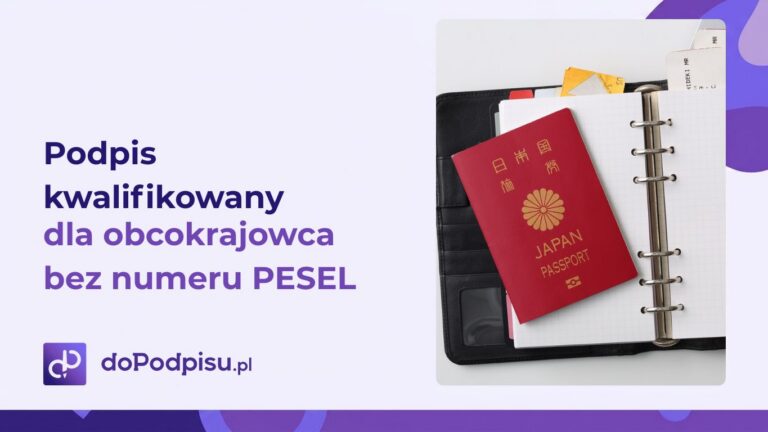
Obtaining a Qualified Electronic Signature (QES) does not necessarily require a Polish PESEL number.
Depending on the provider and the available procedure, identity may be verified using other permitted identification methods.
This means that a foreigner without a PESEL number may also obtain a Qualified Electronic Signature if they meet the identification requirements specified by the provider.
Electronic Signatures on doPodpisu.pl
doPodpisu.pl is a platform for electronically signing and managing documents online. It supports three types of signatures:
- Electronic Signature (SES),
- Advanced Electronic Signature (AES),
- Qualified Electronic Signature (QES).
The platform allows you not only to sign a document but also to manage the entire document workflow. Depending on the selected plan, you can:
- send documents for signature,
- invite multiple people to sign a document,
- set the signing order,
- monitor document status,
- send reminders,
- use signing without logging in,
- store documents in e-Archive,
- verify signed documents,
- use templates and contacts,
- integrate the signing process with other systems via API.
This makes it possible to manage both simple document signing and more advanced processes requiring an Advanced Electronic Signature or Qualified Electronic Signature on one platform.
FAQ – Electronic, Advanced and Qualified Signatures
What is the difference between an Electronic, Advanced and Qualified Electronic Signature?
Electronic Signature (SES) is the basic level of signature. Advanced Electronic Signature (AES) meets additional requirements concerning signatory identification and document integrity. Qualified Electronic Signature (QES) is based on a qualified certificate and has the same legal effect as a handwritten signature under eIDAS.
Is an Advanced Electronic Signature the same as a Qualified Electronic Signature?
No. Advanced Electronic Signature (AES) and Qualified Electronic Signature (QES) are two different types of signatures. QES requires a qualified certificate and has a specific legal effect under eIDAS.
Is an Electronic Signature (SES) legal?
Yes. eIDAS recognizes an Electronic Signature as a form of electronic signature. This does not automatically mean, however, that every document signed with SES meets the requirements applicable to a particular legal transaction.
Does every document need to be signed with a Qualified Electronic Signature?
No. The required type of signature depends on the specific document, transaction, and applicable requirements.
Which signature is equivalent to a handwritten signature?
Qualified Electronic Signature (QES) has this legal effect under eIDAS.
Can all three types of signatures be used on one platform?
Yes. doPodpisu.pl supports Electronic Signature (SES), Advanced Electronic Signature (AES), and Qualified Electronic Signature (QES).
Summary
The three basic types of electronic signatures differ in their requirements and legal effects:
- Electronic Signature (SES) – a basic signature for simple electronic processes.
- Advanced Electronic Signature (AES) – a higher level of signatory identification and document integrity protection.
- Qualified Electronic Signature (QES) – a signature based on a qualified certificate that, under eIDAS, has the same legal effect as a handwritten signature.
The most important thing is to match the type of signature to the specific document and process. Not every document requires a Qualified Electronic Signature, but where such a requirement exists, an Electronic Signature or Advanced Electronic Signature may not be sufficient.
doPodpisu.pl supports Electronic Signature (SES), Advanced Electronic Signature (AES), and Qualified Electronic Signature (QES) as part of one platform for signing and managing documents online.
Note: This information is for educational purposes and presents general differences between electronic signatures. It does not constitute legal advice or a recommendation regarding the appropriate type of signature for a specific document. Where regulations specify a required form of signature, the applicable legal requirements should be verified.
Masz dodatkowe pytania do artykułu lub produktu?
Zostaw dane kontaktowe i porozmawiaj bezpłatnie z konsultantem.